Painter guide
DIY painting versus hiring a pro in inner Brisbane: where the line sits
The honest answer up front
If you can roll a wall and cut a straight line, you can handle some painting jobs yourself. But in inner Brisbane, a lot of the work that looks simple on the surface turns out not to be. The line between "do it yourself and save money" and "pay someone and save your weekend and your walls" usually comes down to the type of surface, the height involved, and how long you want the result to last.
What DIY actually costs you (beyond the tin of paint)
The purchase price of paint is only part of the equation. To do a room properly, you need primer, painter's tape, drop sheets, a quality roller and frame, a cutting-in brush (at least 63mm), a tray, sugar soap, sandpaper, and filler. If you're doing external work, add a ladder tall enough to reach your eaves, or a ladder hire cost.
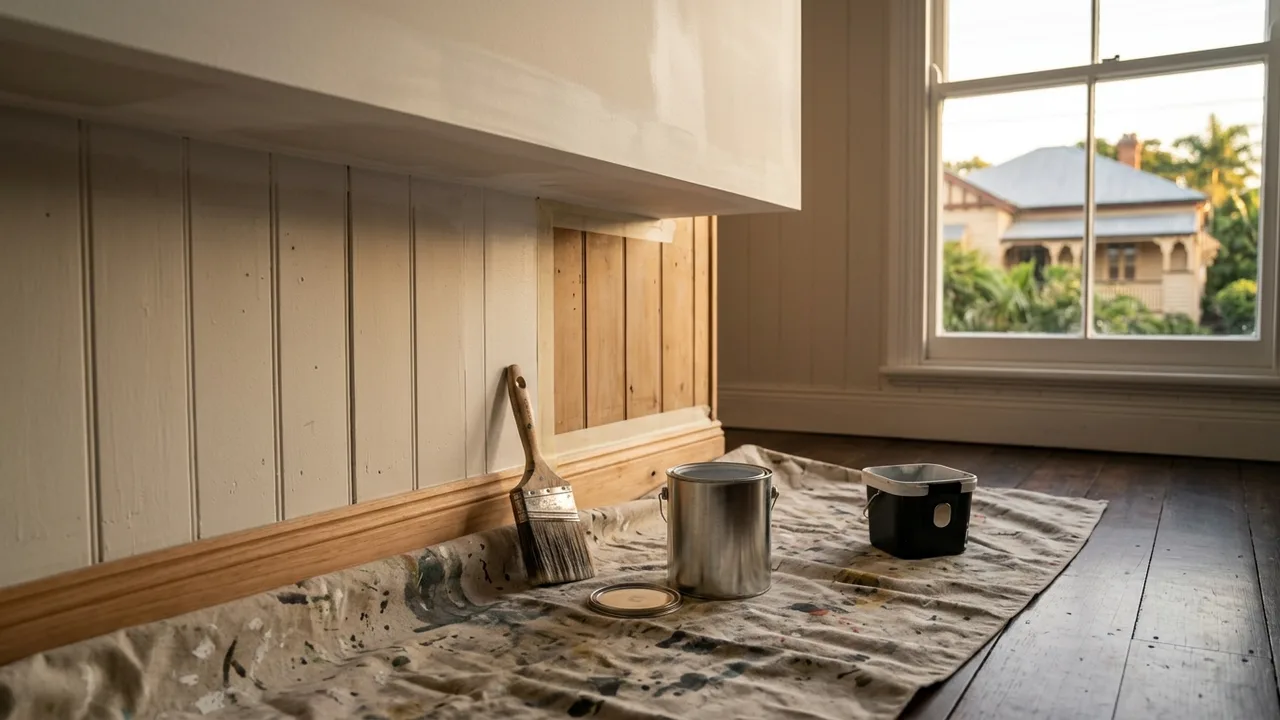
A typical internal bedroom in a New Farm or Windsor terrace runs roughly 40-50 square metres of wall surface once you account for doors and windows. Two coats of quality low-sheen paint plus a primer coat uses more product than most first-timers expect. Figure on $200-$350 in materials alone for a single room if you're buying decent paint rather than the cheapest tin on the shelf.
Then there's your time. A careful DIYer with no experience might spend 10-14 hours on that bedroom. Someone who paints every week does it in three or four. Time has a value, and a weekend lost to prep, painting, and cleanup is a real cost even if it doesn't show up on a receipt.
Where DIY genuinely makes sense:
- A single internal room with no cornices, no stained timber trims, and flat plasterboard walls.
- A small touch-up job on previously painted surfaces in good condition.
- A fence or gate that doesn't need a precision finish.
- You genuinely enjoy it and aren't on a deadline.
Why inner Brisbane's housing stock changes the calculation
Houses in New Farm, Teneriffe, Wilston, Herston, and the surrounding suburbs often aren't the slab-on-ground, plasterboard boxes you might find in newer outer suburbs. A lot of them are Queenslanders or post-war timber homes. Some have been clad in fibro (fibre-cement sheeting) at some point in their history.
Each of those surfaces has specific needs:
Weatherboard timber expands and contracts with Brisbane's humidity swings. Preparation matters enormously. Paint applied over dirty, flaky, or unprimed timber fails faster than almost anything else. Poor prep on the outside of a New Farm Queenslander can mean peeling paint inside 18 months. A professional will typically spend as much time on prep as on the painting itself.
Fibro cladding is worth a specific mention. Older fibro (roughly pre-1990) may contain asbestos fibres bonded into the sheet. Sanding, cutting, or pressure-washing it without proper assessment is a genuine health risk. If your home is pre-1990 and has sheet cladding, get it assessed before you touch it. This is not an area where you want to save money on professional advice.
High ceilings and raked ceilings are common in the area. Cutting in a 3.6-metre ceiling on a narrow stairwell in a Teneriffe townhouse, or working on an ornate cornice in a restored New Farm terrace, is meaningfully harder than a standard flat ceiling. Falls from ladders on internal jobs are more common than most people assume.
Bare masonry and render on the older brick homes around Bowen Hills and Albion behave differently again. They're thirsty surfaces that can absorb a lot of product, and they need specific primers to avoid adhesion failure.
What a professional actually brings (besides a steady hand)
A licensed painter in Queensland holds a Builder - Painter and Decorator (Residential) licence, issued through the QBCC (Queensland Building and Construction Commission). You can verify a licence on the QBCC website. This matters for any external repaint over $3,300 in total labour and materials, because that threshold triggers requirements for written contracts and home warranty insurance in some circumstances.
Beyond the licence, what you're typically paying for is:
- A full day's prep (scraping, sanding, filling, sugar-soaping) before a brush is loaded.
- The right primer for the specific surface, not the generic white stuff.
- Commercial-grade equipment that achieves a more even film thickness.
- Experience with the quirks of older surfaces, including knowing when something needs a different approach mid-job.
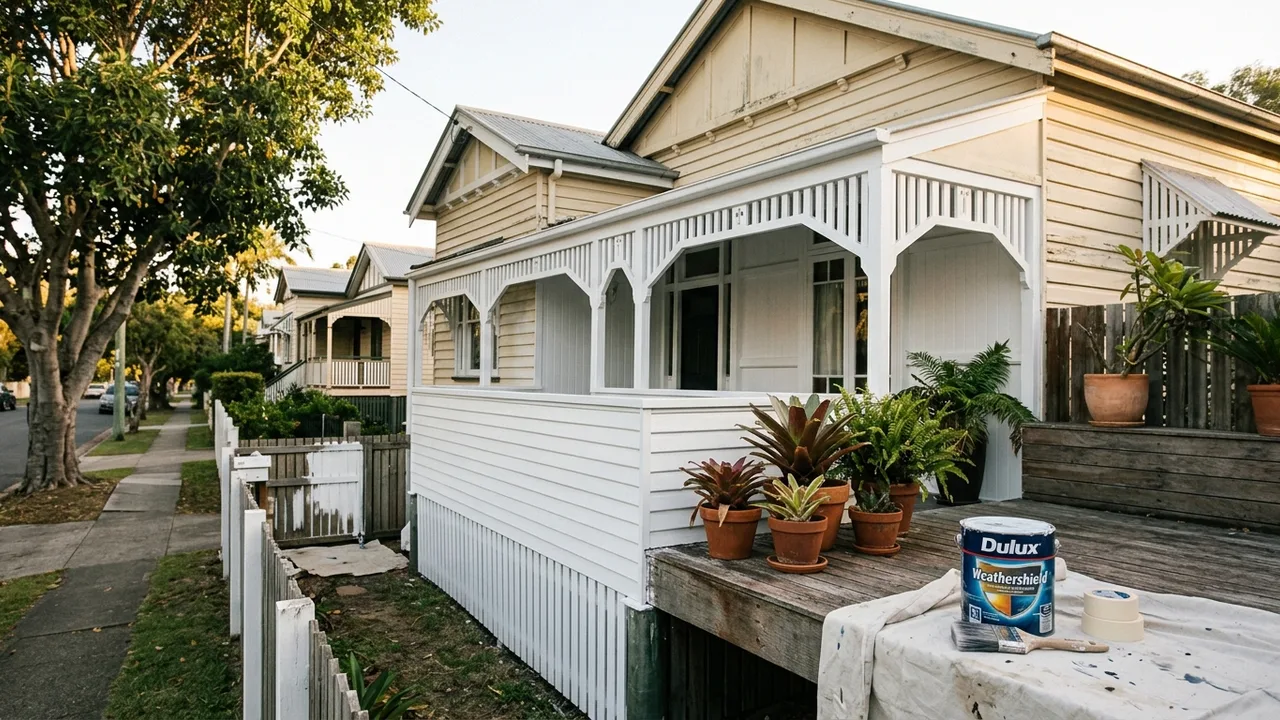
- Speed. A two-person crew can complete an external Queenslander repaint in two to three days that would take a careful DIYer two or three weekends.
For the suburbs in this area, typical professional job values run from about $1,500 for a simple internal room and trim repaint, up to $12,000 or more for a full external repaint of a larger Queenslander with preparation, spot repairs, and a quality finish coat.
The middle ground: splitting the job
Not every part of a painting project has the same difficulty or risk. One honest approach is to do the parts you can handle yourself and engage a professional for the rest.
For example: you might strip and repaint a timber fence on the side of your Wilston property yourself over a couple of weekends. That's low-stakes, low-height, and if the finish isn't perfect, the consequences are minor. Then you engage a professional for the external walls and trim, where height, substrate condition, and finish quality matter more.
Some people also do their own feature wall inside (a flat, single-colour repaint on a clean surface) and have a professional handle the ceilings, cornices, and trim, where the cutting-in work is most visible. That's a reasonable split if you're honest about your skill level.
The trade-off is coordination. It's worth being upfront with any professional you engage about what you've already done yourself, so they can check the prep and flag any issues before they paint over them.
When to stop deliberating and just call someone
There are a few situations where the answer is simply: don't DIY this.
- Any external work above single-storey height, particularly on an elevated Queenslander where the stumps add another metre or more to effective working height.
- Any surface that might contain asbestos.
- Heritage-listed or character-coded properties in the inner suburbs, where the wrong paint system or a botched repair can create real problems with council or body corporate.
- Any job where the substrate is in poor condition and you're not confident diagnosing the cause (rising damp, salt crystallisation on render, previous paint incompatibility).
- Anywhere you need the work to last and look right for at least five years.
The investment in a professional for those jobs is usually smaller than the cost of stripping and redoing failed DIY work.
A straightforward recommendation
Painting isn't a closed trade. You're allowed to do it yourself, and for the right job, it's a reasonable way to save money. But the older housing stock across New Farm, Teneriffe, Windsor, and the surrounding inner suburbs rewards careful preparation and appropriate products in a way that punishes shortcuts.
Be realistic about your available time, your comfort at height, and the condition of the surface you're starting with. If any of those give you pause, the cost of a professional quote is zero, and knowing what a proper job should cost gives you a useful reference point even if you decide to do the work yourself.
If you'd like a quote from a local painter familiar with the area's housing types, this service connects you with providers who work across New Farm, Newstead, Wilston, Windsor, and nearby suburbs. There's no obligation, and no hard pitch. It's just useful to have a number to work from.
Quick answers