Painter guide
Choosing a heritage colour scheme for a New Farm or Teneriffe home
What Makes a Heritage Colour Scheme Work in New Farm and Teneriffe
Choosing a heritage colour scheme for your New Farm or Teneriffe home comes down to two things: understanding what colours were actually used on Queensland workers' cottages and Queenslanders in the late 19th and early 20th centuries, and adapting that palette to your specific streetscape without being slavish about it. Get those two things right and the result looks considered rather than costume-y.
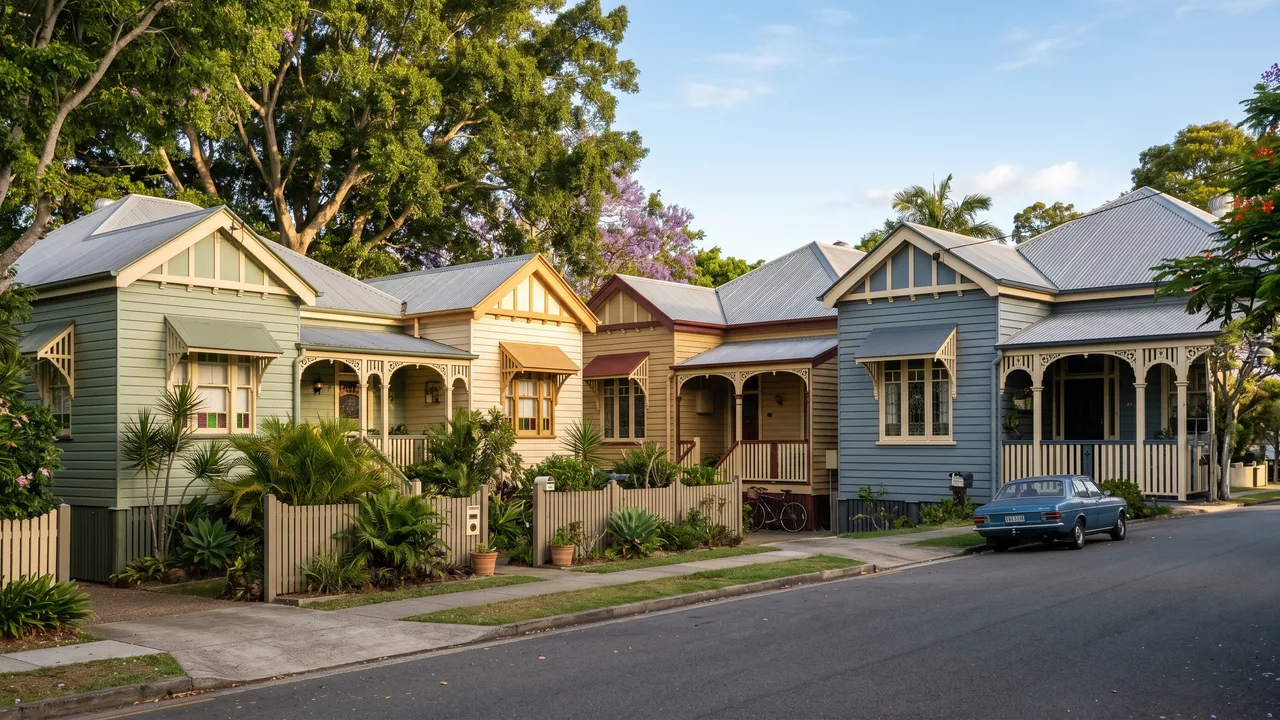
This part of Brisbane's Inner West is dense with intact pre-war housing stock. That context matters. A colour choice that reads beautifully on a freestanding Queenslander in Wilston can feel out of step on a terrace row in Teneriffe. So the suburb, the street, and the architectural style all influence where you land.
What "Heritage" Actually Means for Brisbane Timber Homes
The term gets thrown around loosely. In a paint context, heritage colours refer to the pigment-limited palettes available before synthetic colourants became widespread, roughly pre-1950. Think iron oxides, ochres, raw umbers, lead whites, and the muted mid-tones that those pigments produced.
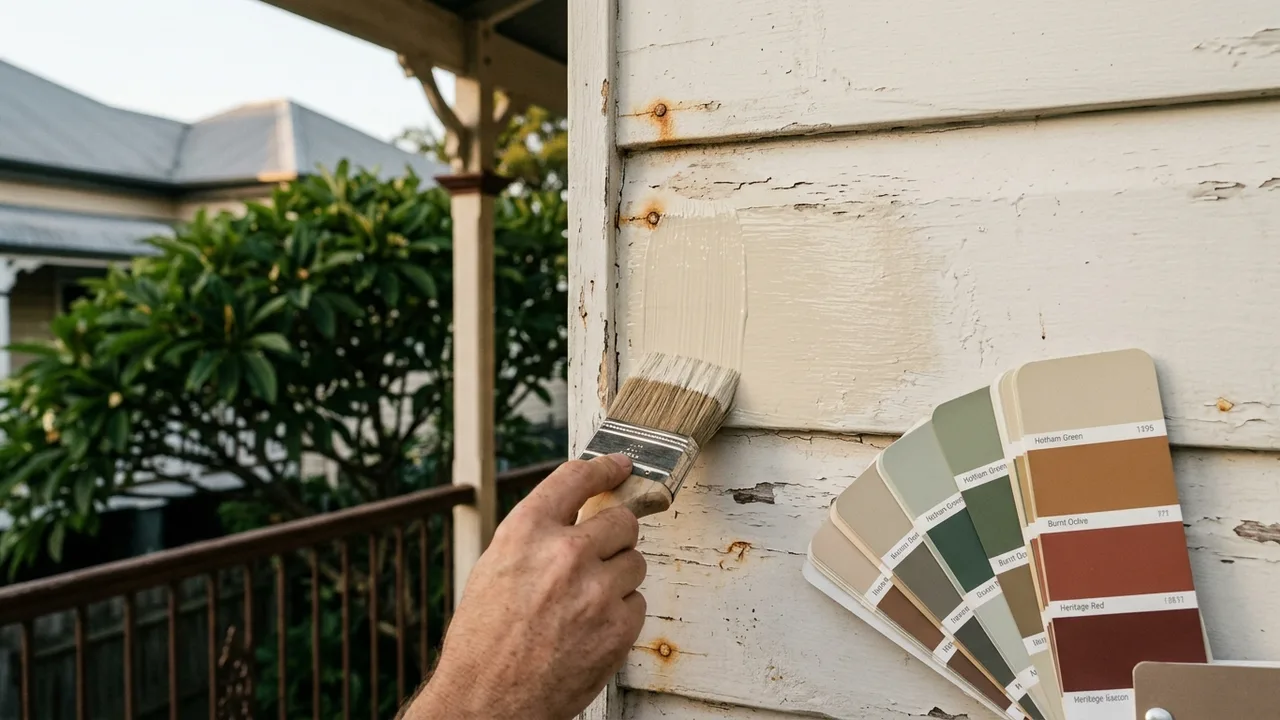
For a typical New Farm worker's cottage or chamferboard Queenslander, the original exterior palette was often surprisingly modest. Body colours tended toward warm off-whites, pale creams, mid-stone tones, or muted greens. Trims were either a contrasting white or cream, or a deeper version of the body colour. Verandah ceilings were almost universally painted in what we now call "haint blue" or a similar pale blue-green, partly for practical reasons (insects, perceived coolness) and partly because it became a regional convention.
Corrugated iron roofs of the era were typically left in their natural galvanised state or painted in dark grey-greens and deep reds once paint became affordable. Roof colour is worth considering alongside wall colour, not as an afterthought.
What heritage colours are not: bright white bodies with stark black trim (that's more Federation formal or a modern interpretation), or the kind of high-contrast deep charcoal schemes popular in contemporary renovations. Those can look good. They just are not heritage.
Reading Your Specific House and Street
Before you open a paint chart, look at the house itself for evidence. Older homes in New Farm and Teneriffe often have paint history buried in the layers on the timber. A painter who knows what they are looking for can sometimes identify the original body colour by scraping back to the first layer, though in most inner-Brisbane houses that have been repainted repeatedly over a century, the original coat is fragmentary at best.
Walk the street and note what your neighbours have done. This is not about copying anyone. It is about understanding the tonal register of the block. Teneriffe's converted wool stores along the riverfront have a very different character to the residential streets running up toward Brunswick Street. New Farm proper, especially around the park precinct, has some of the most intact Victorian and Edwardian streetscapes in Brisbane. Your house sits in that picture whether you think about it or not.
Brisbane City Council's heritage register and the Queensland Heritage Register both list properties and, in some cases, provide guidance documents that reference appropriate colour palettes. If your property is on either register, check whether there are specific conditions around colour. Most heritage-listed homes in this cluster do not have prescriptive colour requirements, but some do. Worth five minutes to confirm before you commit.
The Practical Palette: Body, Trim, Accents, and Ceiling
A workable heritage scheme for a New Farm or Teneriffe Queenslander typically involves four decisions: body colour, trim colour, accent colour (doors, lattice, brackets), and verandah ceiling.
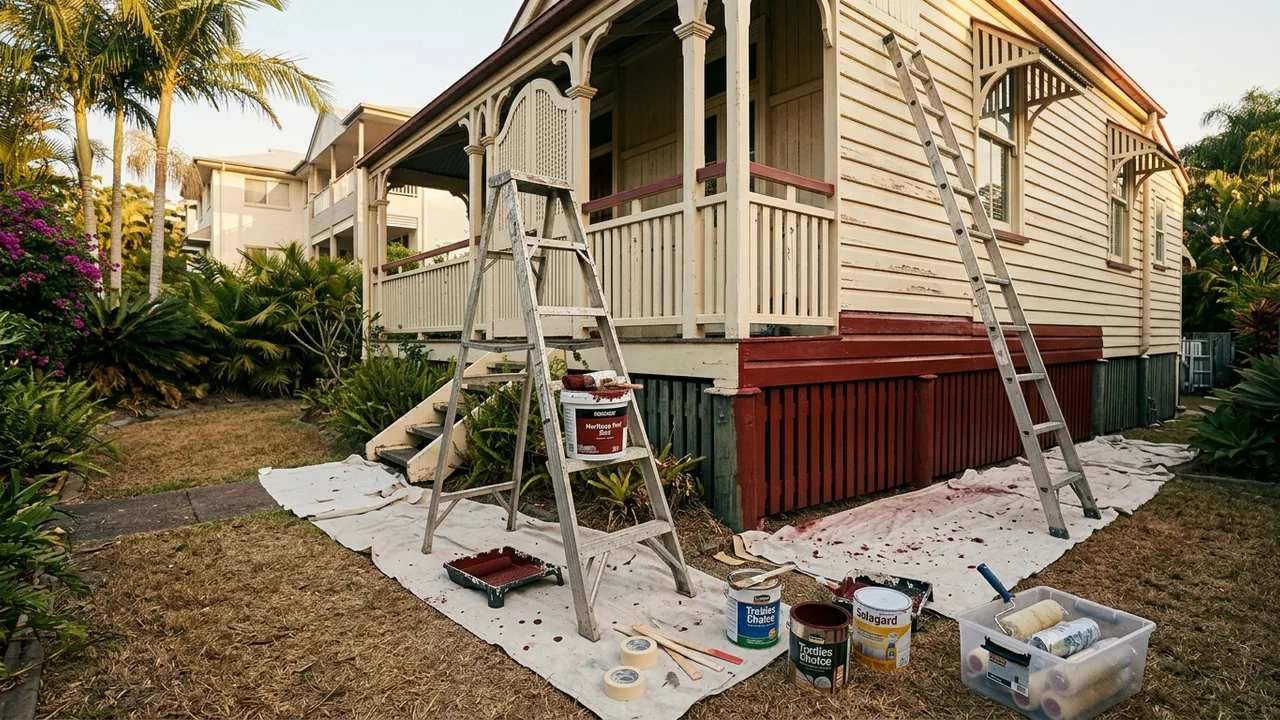
Body colour. The most forgiving approach is a mid-value warm neutral. Colours in the warm stone, pale ochre, greyed sage, or dusty terracotta range tend to sit naturally against the red clay brick plinths and terracotta roof tiles common in this area. Cool grey-white bodies can look sharp but require confident execution; they can read flat against Brisbane's bleaching afternoon sun.
Trim colour. Traditional trim is lighter than the body, typically a cream or off-white rather than a stark pure white. Pure brilliant white (BR-brand tinting bases pushed to maximum brightness) reads as modern and can make original timber joinery look cheap by comparison. A warm white or antique white gives the same contrast with more period sympathy.
Accent colour. Front door, window sashes, decorative brackets, and lattice panels give you room to introduce a deeper tone. Deep Brunswick green, Indian red, bottle green, colonial navy, and Federation burgundy are all historically defensible choices. One accent colour is usually enough. Two requires careful management or things start to look busy.
Verandah ceiling. Pale blue-green is the convention and it remains a practical one in Brisbane's climate. Products labelled "verandah blue" or "ceiling blue" by most major paint manufacturers are formulated for the purpose. If the pale blue does not suit your scheme, an off-white or the body colour in a lighter value are reasonable alternatives. What tends not to work is a ceiling in a strong colour; it compresses the space.
Trade-offs Worth Thinking Through
Strict heritage accuracy versus liveability. Historically accurate colours are not always the most flattering in a modern context, especially if your interior finishes, garden, or adjacent structures do not support them. There is no shame in taking a heritage-informed approach rather than a strict reproduction approach. Most experienced painters working in New Farm will tell you that clients who want "exact period colours" often change their minds once they see a large sample on the wall.
Lighter versus darker body colours. Lighter bodies show dirt faster on the lower weatherboards (Brisbane's humidity and mould are real factors here) but reflect more heat, which matters in an uninsulated Queenslander. Darker bodies hide grime longer and can lift a street presence, but they absorb heat and can fade noticeably in the western and northern sun exposures common in this suburb's grid.
Premium versus standard paint. On an older timber house with repaint cycles typically every 8-12 years depending on exposure, the extra cost of a premium exterior acrylic is generally worth it. The price difference between a standard product and a premium one is usually $80-$150 per 10 litres, but on a full repaint that might be $400-$600 additional across the whole job. Given that labour typically represents 60-70% of a total repaint cost in this bracket, saving on paint to cut overall cost is a poor trade.
DIY colour selection versus paying for a consult. A colour consultation with a professional colour consultant typically runs $250-$450 for an on-site visit in this area. For a home where a repaint might cost $5,000-$10,000 and you will live with the result for a decade, that is a reasonable investment. Several consultants who work in Brisbane's inner suburbs have specific knowledge of heritage palettes and can save you from a colour that seemed right on a chip and wrong on the house.
Getting the Execution Right
A good colour scheme on a poorly prepared surface is still a poor repaint. New Farm and Teneriffe homes typically have significant weatherboard maintenance requirements: checking for rot, reseating loose boards, filling gaps, and priming bare timber properly before topcoat. Heritage homes often have lead paint in the older layers, which requires safe handling and disposal under Queensland WorkSafe guidelines. Any painter you engage should be able to confirm how they handle lead paint mitigation on pre-1970 homes.
Sheen level also matters more than people expect. A low-sheen exterior acrylic is typically the right choice for wall surfaces on timber homes; a semi-gloss or gloss on trim emphasises the joinery detail that makes these houses distinctive. Flat or matt finishes on exterior timber are not recommended for Brisbane's wet seasons.
A Final Thought Before You Decide
The best outcome for a heritage home in New Farm or Teneriffe is a scheme that the house seems to have always worn. That usually means restraint: fewer colours, quieter contrasts, and letting the architecture do the work rather than asking the paint to perform.
If you are unsure where to start, get three or four large sample pots and paint A4-sized patches in different aspects of the house. Look at them at 7am, midday, and dusk. What reads as "warm stone" in a paint store can look very different at noon on a north-facing weatherboard. Give yourself a week before you commit.
A local painter with specific experience in heritage homes in this pocket of Brisbane will often have strong opinions about what works on these streets, and those opinions are worth asking for.
Quick answers