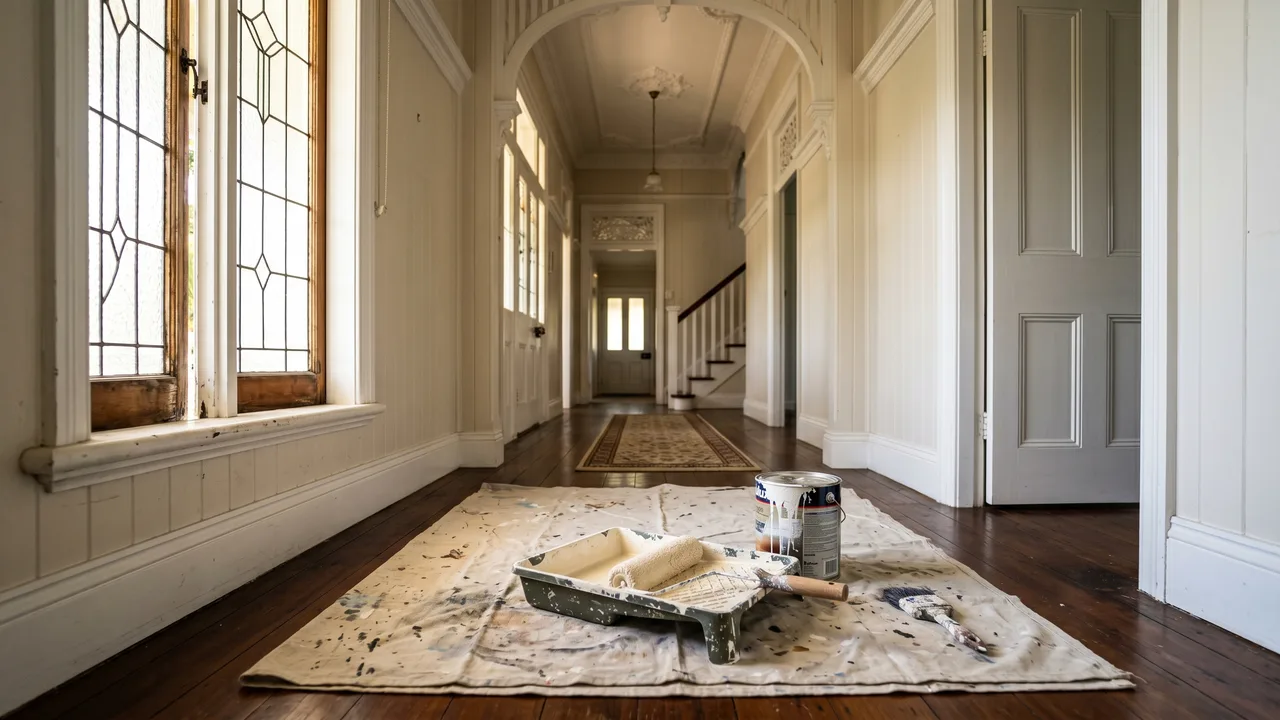
Painter guide
What actually drives the cost of a painting quote in Brisbane?
What Actually Drives the Cost of a Painting Quote in Brisbane?
The short answer: surface area and surface condition. Those two factors account for more of the price variation between quotes than almost anything else. Everything else, from paint grade to access equipment, adjusts the number up or down from that baseline.
Understanding what painters are actually pricing when they hand you a quote makes it much easier to compare them fairly, ask the right questions, and spend money where it genuinely counts.
Surface Area: The Starting Point Every Painter Uses
Painters measure jobs in square metres. Interior walls and ceilings are calculated separately, and trim, doors, and architraves are typically priced per linear metre or per item. On an average three-bedroom home in New Farm or Windsor, interior wall area alone can run to 300-400 square metres once you account for both sides of internal walls, hallways, and stairwells.
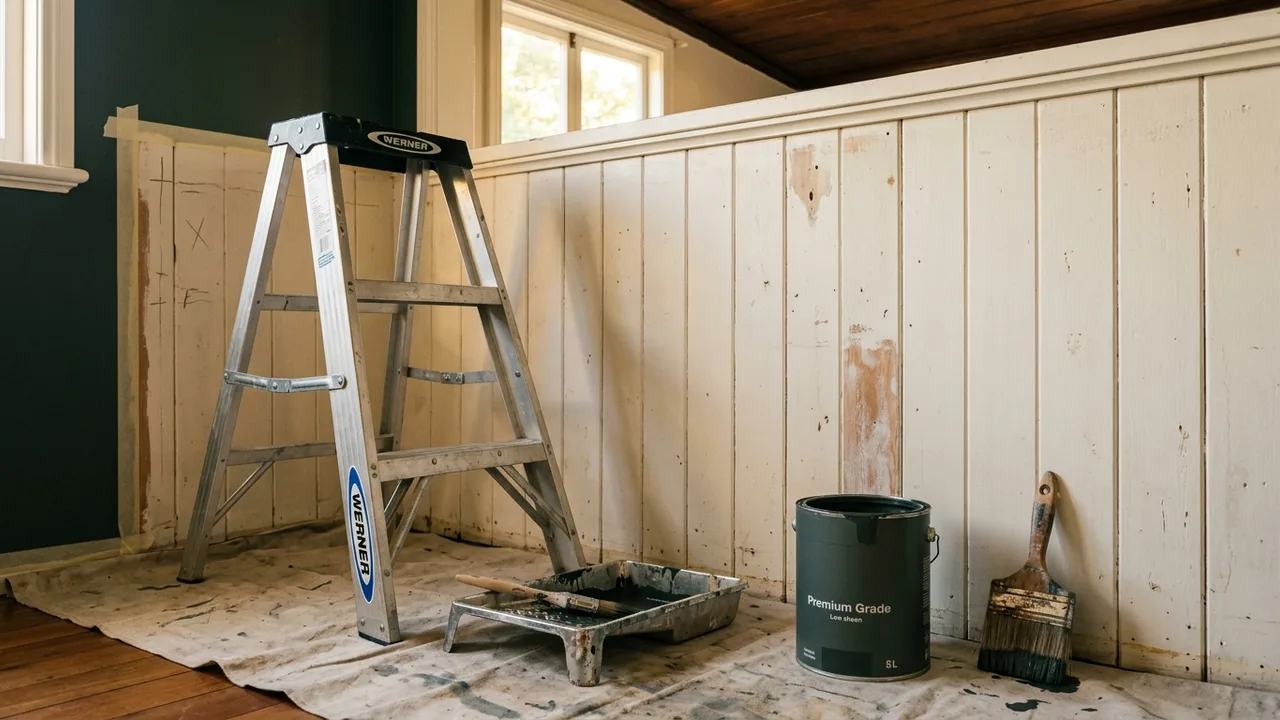
Exterior jobs add another layer of complexity. A two-storey Queenslander in Wilston or Albion has a dramatically larger paintable surface than a single-storey brick veneer of the same floor plan, because the external cladding, posts, railings, fascias, and eaves all add up fast. High-set Queenslanders in this part of Brisbane are common, and painters working on them know to build in time for the work below the house as well as the main structure above.
The practical takeaway: before you call a painter, walk through the property and note anything you want excluded. Painters will sometimes quote everything they can see unless you tell them otherwise.
Surface Condition: Where Quotes Diverge Most
This is where two quotes on the same house can be $2,000 apart and both be entirely honest.
Preparation work, not paint, is what separates a finish that lasts eight years from one that starts peeling in three. Prep includes:
- Scraping and sanding loose or flaking paint
- Filling cracks, holes, and gaps in plaster or timber
- Priming bare or porous surfaces
- Sanding back gloss surfaces so the new coat adheres
- Treating mould or mildew before painting over it
In the Inner West and inner north of Brisbane, older Queenslanders with timber weatherboard cladding often carry decades of paint layers. Some of those layers contain lead paint, which requires special handling and disposal procedures. A painter who prices in lead paint management is doing the right thing; one who quotes without asking about the house's age may be leaving that cost out entirely, only to raise it later.
Mould is another Brisbane-specific factor. High humidity through summer and wet season creates conditions that encourage mould growth inside and out, particularly on south-facing walls and in poorly ventilated bathrooms. Surface treatment before painting is not optional; painting over active mould is a short-term fix that fails quickly.
As a rough guide, extensive prep on a weatherboard exterior can add $800 to $2,500 to a quote compared to a job on a house with a clean, well-maintained surface.
Paint Grade and the Real Cost of Going Cheap
Paint is one place where the trade-off between upfront cost and long-term value is genuinely clear. Premium acrylic exterior paints (Dulux Weathershield, Taubmans All Weather, and similar products) typically cost $80-$120 per ten-litre pail at retail. Budget equivalents can be half that.
The difference shows up in coverage rate, flexibility as the substrate moves with Brisbane's temperature swings, and resistance to UV fade. With Brisbane's sun intensity, exterior surfaces take a beating. A painter using two coats of a quality product on a prepared surface is likely to give you a finish that holds well for seven to ten years. A single coat of budget paint on a questionable surface may look fine at handover and deteriorate significantly within two to three years.
When you get a quote, ask specifically: what product are they specifying, and how many coats? A quote that doesn't answer both of those questions is incomplete. Some painters will note it in writing; others you have to ask directly.
It is worth knowing that paint typically represents 20-30% of a job's total cost. Labour is the dominant expense, which is why cutting prep time (rather than paint grade) is where corners most often get cut.
Access and Site Complexity
Working at height costs money, and Brisbane's elevated housing stock means access requirements come up constantly.
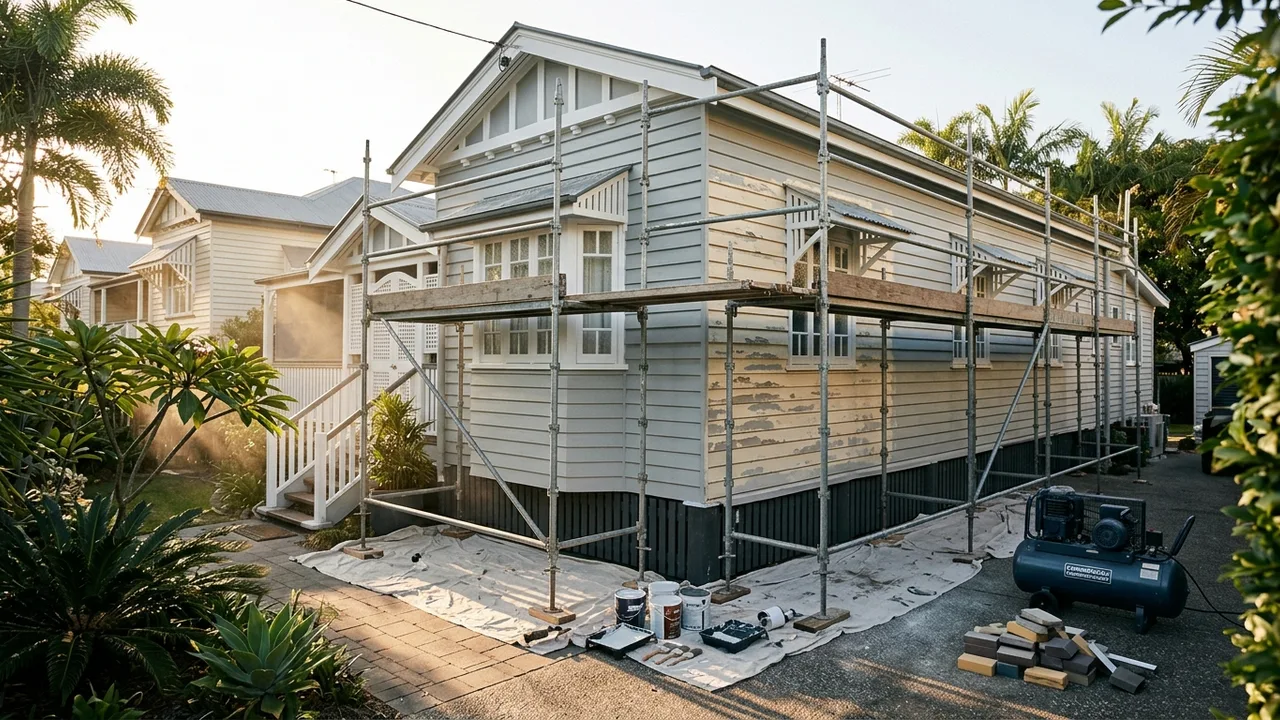
For a single-storey house, a painter might work entirely from ladders. For a two-storey Queenslander or a multi-level property on a sloping New Farm or Teneriffe block, scaffolding or an elevated work platform (EWP) may be needed. Scaffold hire alone can add $600 to $1,800 to a job depending on how much of the house it needs to cover and how long it sits there.
Interior access has its own complications. High ceilings, a feature common in older homes across Herston, Bowen Hills, and Newstead, require extension poles and sometimes low-level platforms. This slows the work and adds time.
Stairwells are notoriously fiddly. They combine height, awkward angles, and limited space in a way that makes them slower to paint per square metre than a straight wall. Painters know this and price it accordingly; a stairwell that looks like a small area on paper can take a full day of careful work.
If your property has restricted vehicle access (narrow laneways are common around New Farm and Teneriffe), that can also affect how equipment is brought in and how long setup takes.
Number of Colours and Finish Types
Colour changes and finish types have a measurable effect on price, though it is usually smaller than prep or access.
Each colour change on a wall requires the painter to clean brushes and rollers between coats or switch equipment entirely, which takes time. Feature walls in a contrasting colour are common in the Inner West's terrace-style apartments and renovated Queenslanders, and they add a line item that is easy to forget when estimating.
Finish type also matters. High-sheen finishes (semi-gloss or gloss) are more durable and easier to clean, which is why they are standard on trim, doors, and wet areas. But they are less forgiving of surface imperfections; every small flaw shows up under sheen. That means more prep time before applying a gloss finish than a flat or low-sheen.
If you are moving from a dark colour to a lighter one, expect to hear about additional coats. Going from deep charcoal to off-white on a feature wall can require three coats instead of two to achieve even coverage, and that goes straight to the quote.
What a Fair Quote Process Actually Looks Like
A painter who quotes well will visit the property rather than estimate by photo or phone. They will walk through the space, note problem areas, confirm what you want included, and ask about your timeline and any constraints (pets, young children, rental tenancy, body corporate requirements for strata properties).
A written quote should specify: the rooms or areas included, the products being used, the number of coats, what prep work is included, and the payment schedule. If any of those elements are missing, ask before you sign.
Getting two or three quotes is sensible, not insulting. The goal is not to find the cheapest price; it is to find a quote that is specific enough that you can actually compare it with another. A vague quote is hard to evaluate because you cannot tell what you are buying.
One honest note: in the $1,500 to $12,000 range that covers most residential painting jobs in inner Brisbane, the difference between quotes often comes down to the assumed amount of prep work. Clarifying that single variable will explain most of the gap between a high and a low quote.
If you want to connect with a painter who works across New Farm, Newstead, Teneriffe, and the surrounding suburbs, we can help with that. There is no pressure, and the conversation starts with a site visit.
Quick answers